In the 1960’s when I was only about to be born, dear missionaries were living in very difficult living conditions in the deep jungles of Venezuela trying to learn this most difficult Piaroa language. Fred Findley, together with his wife Barb Findley, Fred’s parents and particularly Marylou Yount (my dear coworker of many years who was a grammarian) were hammering out a complete orthography of this complex language which uses phonemic nasal tones, has thee different t’s, p’s and c’s, glottal stops as well as gender specific verbs. After identifying all the sounds which the P language uses, they chose any symbols possible which the Spanish language uses for the same sound so as to not replicate symbols for the same sound which would be common to both Spanish and Piaroa. Spanish is the national language of the country and every Piaroa person rubs shoulders with it. Today many Piaroa are bilingual and so the wisdom of these early missionaries has paid off today.
This is the orthography (spelling system) which they developed.
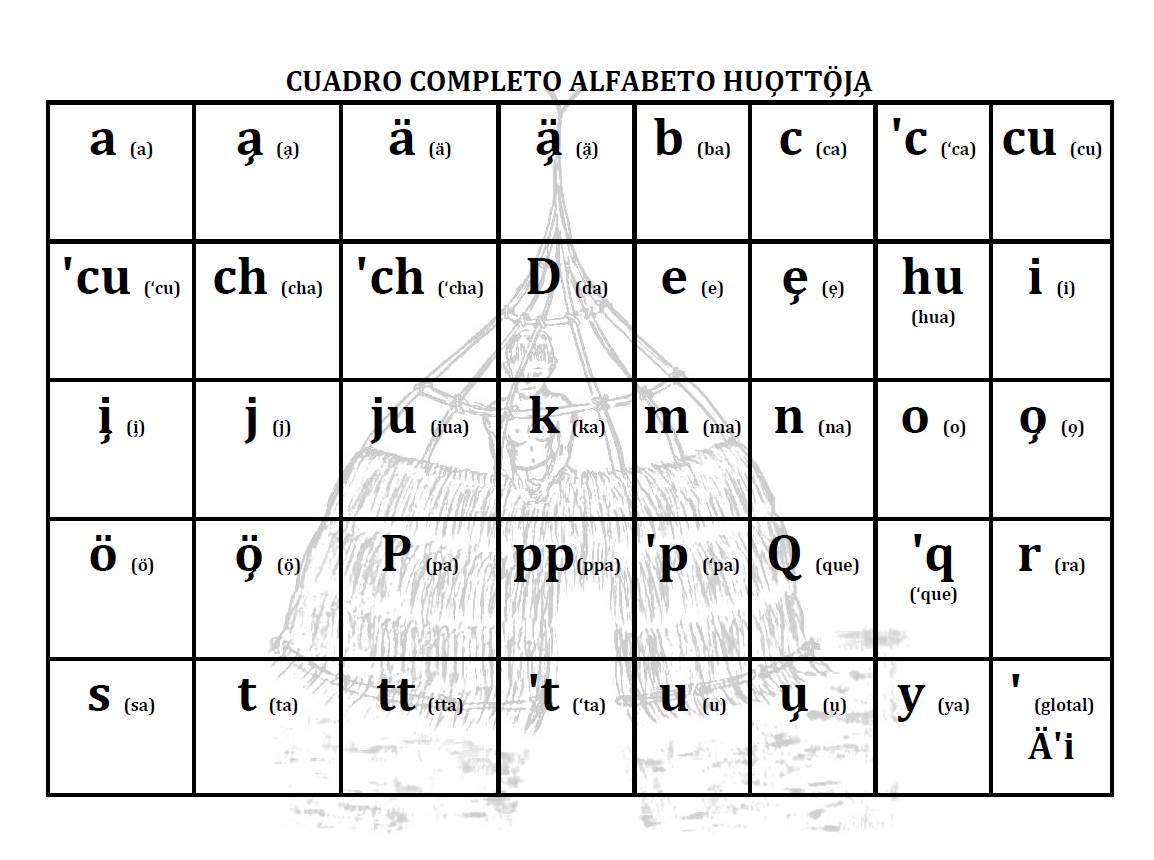
This alphabet chart which you see above, was created by the Piaroa who learned it from the missionaries. As you are aware, it was submitted recently to the Institute of Languages in Venezuela with the request to make it legal. Robin and I joined the work in 1989. As a newcomer, I observed the method of education which was in place. Small primers were printed by the mission and given to the people. Missionaries had literacy classes, but primarily what I observed was the people themselves trying to learn. Young and old, they labored in their huts to capture these visual symbols of the sounds their tongues made (imagine how hard it would be for you and I to learn the Chinese Hanzi writing system in our spare time). Education and knowledge is highly valued in the Piaroa culture. Parents would learn and teach their children, but the effectiveness of attaining a complete level of literacy was very rare. Some could read, but very laboriously. As I observed this I also noticed that in each Piaroa village was a government school. Piaroa who were ‘upper crust’ culture would go to school in town and learn Spanish at about a 5th grade level. With this education, they qualified to become school teachers in the government indigenous school system which had a school in every Piaroa village. But the Piaroa school teachers would teach Spanish curriculum only, in their broken Spanish to the children of their own people in the village. I always wondered, “Why don’t they teach Piaroa too?!!!“, “Why don’t they teach these children also to read their own language?!!”
That question lingered on in my mind for years. I would talk to the school teachers personally and encourage them to teach P in school, but their blank look and lack of response told me that they were likely not authorized to do so and their job was on the line. Then this past year, as you are aware, I was introduced to Tomás, through my brother and his wife’s mission outreach in Venezuela. When ‘by coincidence’ I became aware that Tomás was the Director of Education in the state that he lives in I pursued the question with him. “Tomás, how can we get the Piaroa alphabet into the Piaroa Indigenous School System?“… and you know the rest of that story.
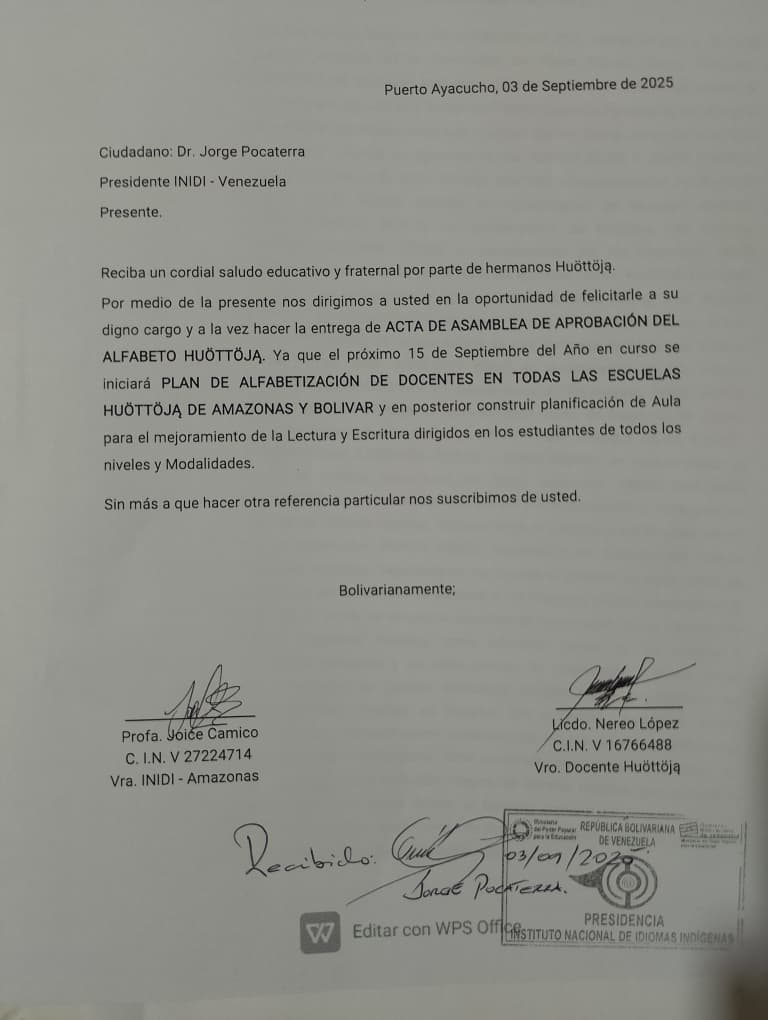
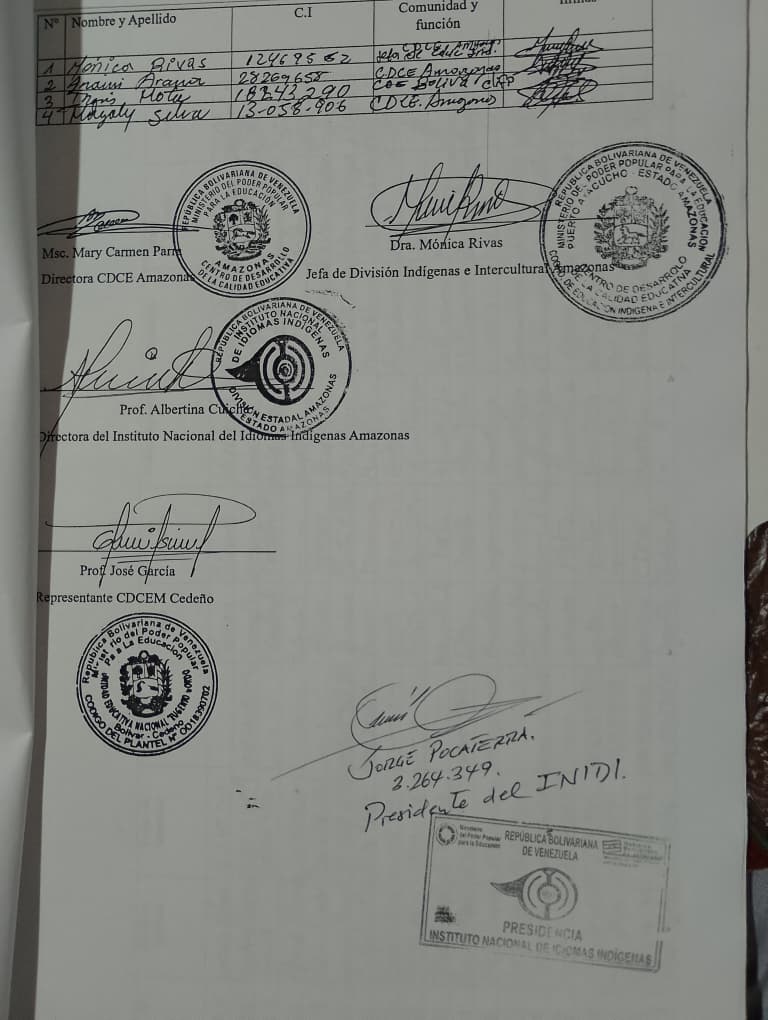
Today, it is my joyous privilege to announce to you, that through Tomás and your prayers, the Piaroa language and alphabet which these pioneer missionaries crafted, has now been legally recognized and approved as an official language of Venezuela! In addition to this, the government has mandated it’s inauguration to be effective staring on September 15th, just five days from today!!! How wonderful to think that in every Piaroa school, (there are hundreds of them throughout the P nation), the school teachers will now be able to start teaching the P children in their own language and get paid for it! Above is a photo of the legal document signed and sealed by the President of the I.O.L. in Caracas.
All for now, more to come,
t.